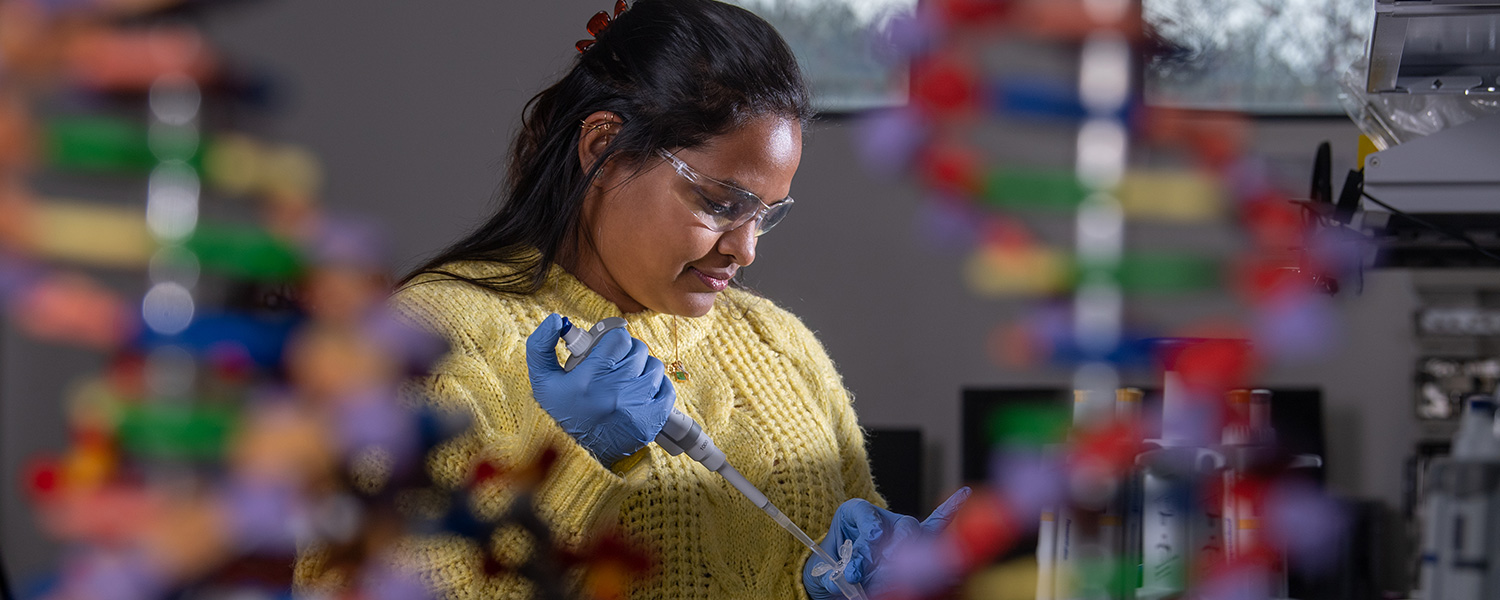
Every day at Kent State, a student walks into a laboratory for the first time. A faculty member partners with a local school district to solve a community challenge. A researcher collaborates with NASA, healthcare providers or manufacturers to answer questions that matter beyond campus.
Those moments may happen quietly, but they tell the story of what it means to be one of the nation's leading research universities.
Kent State researchers are solving today's challenges while preparing tomorrow's innovators. Our research program has evolved from a strong regional presence to one of the nation's premier research universities. Today, research is embedded throughout the university's mission—bringing together faculty, students, industry, government agencies and community partners to solve real-world problems while providing students with experiential learning opportunities that prepare them for future leadership in every field.
Overseen by the Division of Research and Economic Development, the university’s research spans a wide range of disciplines and emphasizes interdisciplinary collaboration, recognizing that society's biggest challenges require expertise from multiple fields.
Among the Top 5% of U.S. Research Institutions

In 2022, Kent State earned the prestigious Carnegie Research 1 (R1) designation—the highest classification for research universities in the United States. Kent State successfully maintained that designation under Carnegie's updated methodology in 2025.
Used as a national benchmark to identify the country's most research-intensive universities, the Carnegie Classification requires an institution to spend at least $50 million annually on research and development and award at least 70 research doctoral degrees each year. Kent State has exceeded both benchmarks, firmly securing its place among the nation's leading research universities.
Today, only 187 universities nationwide hold the R1 designation, placing Kent State among approximately the top five percent of research institutions in the United States. It is also one of only seven universities in Ohio to achieve this distinction.
"The R1 designation underscores the excellent research conducted by our faculty. It is this research that Kent State students assist with and thereby gain state-of-the-art experience and critical thinking skills that prepare them for not only graduate school but for succeeding in any subsequent occupation," said Doug Delahanty, Ph.D., Vice President, Research and Economic Development
Addressing Society’s Most Pressing Challenges
Overseen by the Division of Research and Economic Development, the university’s research spans a wide range of disciplines and emphasizes interdisciplinary collaboration, recognizing that society's biggest challenges require expertise from multiple fields. Current research includes:

Community Engaged Research Institute (CERI)
The institute and the City of Cleveland are partnering on a new research and training initiative designed to strengthen trust and collaboration between the Cleveland Division of Police and residents. The pilot program brings together Kent State researchers, police leaders, community representatives and city staff for evidence-based training and collaborative problem-solving. Led by criminologist Elias Nader, Ph.D., the project will examine community perceptions of safety, accountability and trust through resident surveys and listening sessions across Cleveland’s five police districts. The initiative also provides hands-on research opportunities for Kent State students while helping inform future strategies for community engagement and public safety.
Human Performance, Education, Research and Outreach Initiative (HERO)
A new HERO Initiative project, 24-Karat Mindset, is helping student-athletes build the mental toughness needed to succeed on the field, in the classroom and in everyday life. Led by sport psychologist John Gunstad, Ph.D., the program adapts strategies used by military personnel and first responders for the unique challenges faced by student-athletes. Participants develop personalized goals and receive one-on-one and group training focused on performing under pressure, recovering from injury and maintaining a healthy sport-life balance. The program takes a whole-person approach to helping student-athletes build resilience and perform at their best.
Healthy Communities Research Institute (HCRI)
In Newburgh Heights, a Cleveland-area community surrounded by a history of industrial activity, residents are helping researchers turn generations of environmental knowledge into community health science. Healthy Communities Research Institute researchers pair GPS-enabled video narratives—in which residents document what they see, smell, remember and worry about—with anonymous, noninvasive saliva samples that reveal biological markers associated with inflammation and long-term environmental stress. By combining lived experience with scientific data, the project creates a model for community-led public health research. The goal is to give residents high-quality evidence to support environmental monitoring and hazard reduction—while keeping their stories, data and privacy under their control.